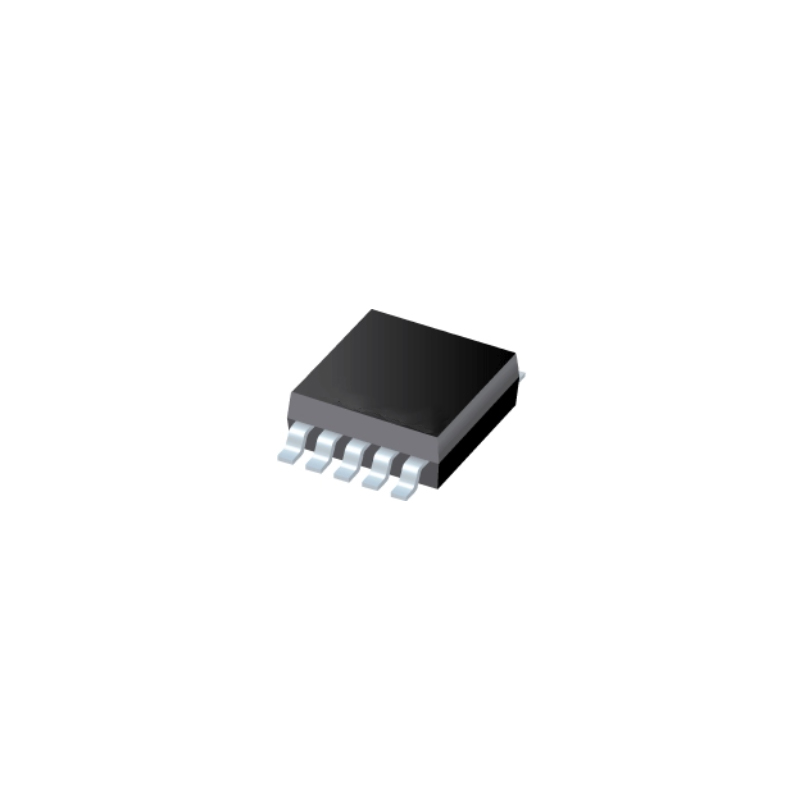
Key Featrues
High-Precision 16-Bit ADC: The ADS8681, ADS8685, and ADS8689 feature a 16-bit successive approximation register (SAR) ADC, ensuring high-resolution data acquisition. This precision is critical for applications requiring accurate signal measurement, such as industrial automation, medical instrumentation, and test equipment, where even minor errors can significantly impact performance.
Software-Programmable Input Ranges: The devices support both bipolar and unipolar input ranges, including ±12.288 V, ±10.24 V, ±6.144 V, ±5.12 V, and ±2.56 V, as well as unipolar ranges up to 12.288 V. This flexibility allows users to adapt the ADC to various signal levels without external circuitry, simplifying system design and enhancing versatility across diverse applications.
High Input Impedance and Overvoltage Protection: With a constant input impedance of ≥1 MΩ and overvoltage protection up to ±20 V, the devices ensure robust performance in harsh environments. This feature prevents damage from voltage spikes and maintains signal integrity, making the ADC suitable for industrial and automotive applications where electrical noise and transient voltages are common.
Integrated Analog Front-End (AFE) and On-Chip Reference: The integrated AFE and 4.096-V reference with low temperature drift reduce the need for external components, lowering system complexity and cost. The AFE ensures accurate signal conditioning, while the stable reference minimizes errors due to temperature variations, improving overall system reliability and accuracy.
High-Speed Sampling and MultiSPI Interface: The devices offer sampling rates up to 1 MSPS (ADS8681), 500 kSPS (ADS8685), and 100 kSPS (ADS8689), enabling fast data acquisition for dynamic signal processing. The multiSPI interface, compatible with traditional SPI and daisy-chain configurations, simplifies integration with microcontrollers and digital systems, enhancing system efficiency and scalability.
Applications
Direct Sensor Digitizer: The ADS8681, ADS8685, and ADS8689 are ideal for directly digitizing signals from high-impedance sensors, such as thermocouples, strain gauges, or pH sensors. Their constant resistive input impedance (≥ 1 MΩ) and software-programmable input ranges ensure accurate measurements across a wide variety of sensor types, making them suitable for precision sensor applications in scientific and industrial environments.
Industrial Automation and Control: These devices are well-suited for industrial automation systems, where they can digitize signals from sensors monitoring pressure, temperature, or flow. The integrated overvoltage protection (up to ±20 V) and bipolar/unipolar input ranges allow for robust operation in harsh industrial environments, ensuring reliable data acquisition.
Power Monitoring and Energy Management: The ADS868x family is ideal for power monitoring applications, such as digitizing voltage and current signals in energy meters or power distribution systems. The high-resolution (16-bit) ADC and low-drift on-chip reference ensure precise measurements, while the multiSPI interface simplifies integration with microcontrollers for real-time energy management.
Medical Instrumentation: These ADCs are suitable for medical devices requiring high-precision signal acquisition, such as patient monitoring systems or diagnostic equipment. The high SNR (92 dB) and low THD (-107 dB) ensure accurate digitization of low-amplitude biomedical signals, while the extended temperature range (-40°C to +125°C) supports operation in demanding medical environments.
Test and Measurement Equipment: The ADS868x series is ideal for use in test and measurement systems, such as oscilloscopes or data loggers, where high-speed, high-accuracy digitization of analog signals is required. The programmable input ranges and excellent DC precision (DNL: ±0.4 LSB, INL: ±0.5 LSB) make these devices versatile for a wide range of measurement applications.