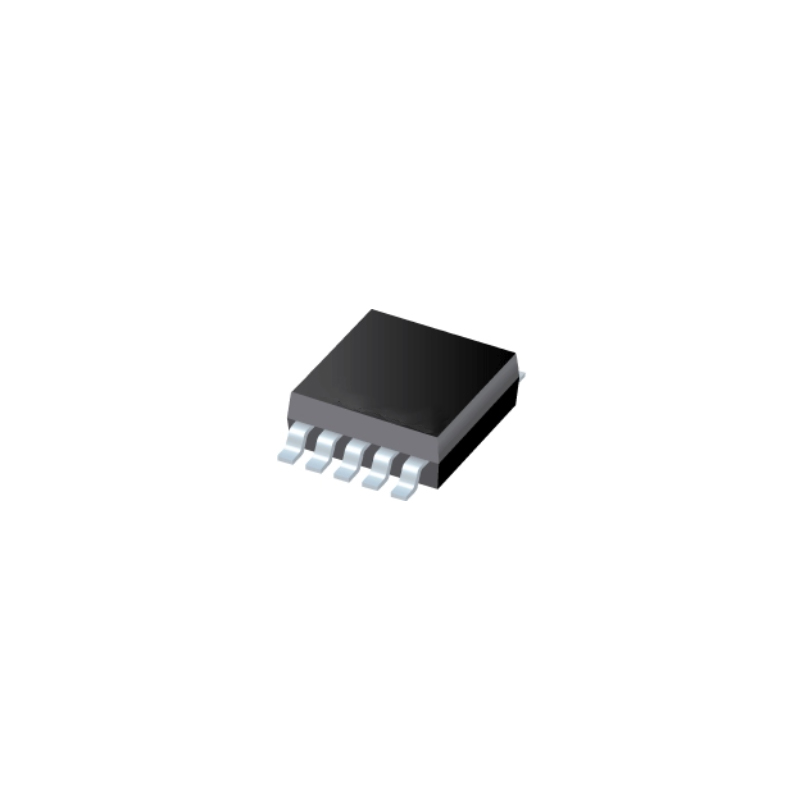
Key Featrues
Dual-Channel, 1024-Position Resolution: The ADN2850 offers dual-channel digital potentiometers with 1024-step resolution, providing precise and fine-grained control over resistance settings. This high resolution enhances accuracy in applications such as audio volume control, sensor calibration, and programmable gain amplifiers, ensuring optimal performance and user experience.
Nonvolatile Memory with EEMEM: The device features nonvolatile memory that stores wiper settings, allowing the system to retain its configuration even after power cycling. This ensures consistent performance and eliminates the need for reprogramming, improving efficiency in applications like industrial automation and consumer electronics.
Low Temperature Coefficient (35 ppm/°C): With a low temperature coefficient, the ADN2850 maintains stable resistance values across a wide temperature range (-40°C to 85°C). This stability is critical in environments with fluctuating temperatures, such as automotive or outdoor applications, ensuring reliable and consistent operation.
SPI-Compatible Serial Interface: The SPI interface enables easy integration with microcontrollers and other digital systems, offering versatile programming options. This simplifies system design and allows for advanced features like cascade pin functionality, making it suitable for complex electronic systems and programmable devices.
Wide Supply Voltage Range (2.7V to 5.5V): The ADN2850 supports both single and dual supply voltages, making it adaptable to various power supply configurations. This flexibility expands its use cases in battery-powered devices, portable electronics, and dual-supply systems, enhancing its versatility and application scope.
Applications
Precision Audio Volume Control: The ADN2850 is ideal for precision audio volume control in high-fidelity audio systems. Its dual-channel, 1024-position resolution ensures smooth and accurate volume adjustments, while its SPI interface allows for seamless integration with digital audio processors. The nonvolatile memory ensures that the volume settings are retained even after power cycles, making it suitable for professional audio equipment and home theater systems.
Programmable Gain Amplifier (PGA): The ADN2850 can be used in programmable gain amplifiers to adjust the gain of analog signals in real-time. Its 250 kΩ resistance and 1024-step resolution allow for fine-tuning of gain settings, making it suitable for applications in medical instrumentation, data acquisition systems, and industrial control systems where precise signal amplification is required.
Automotive Climate Control Systems: The ADN2850 is well-suited for use in automotive climate control systems, where it can be used to adjust the resistance in temperature sensors and control circuits. Its wide operating temperature range (-40°C to 85°C) and robust design ensure reliable performance in harsh automotive environments. The nonvolatile memory feature ensures that user settings are preserved, even after the vehicle is turned off.
Industrial Process Control: The ADN2850 can be used in industrial process control systems to adjust the resistance in control loops for precise regulation of process variables such as temperature, pressure, and flow. Its SPI interface allows for easy integration with microcontrollers and PLCs, while its 1024-step resolution ensures accurate control. The device's low temperature coefficient and nonvolatile memory make it ideal for use in environments where long-term stability and reliability are critical.
LED Brightness Control: The ADN2850 is ideal for controlling the brightness of LEDs in lighting systems. Its dual-channel capability allows for independent control of multiple LED strings, while its 1024-step resolution ensures smooth and precise brightness adjustments. The SPI interface enables easy integration with lighting control systems, and the nonvolatile memory ensures that brightness settings are retained even after power cycles, making it suitable for both commercial and residential lighting applications.